The UX Writing Agent
A Figma plugin that rewrites copy at design time. It suggests fixes, flags missing strings, removes what shouldn't be there — and applies the change to your Figma frame in one click.
Built with
Claude Code · vanilla JS · no build step
Powered by
Claude Sonnet 4.6 · Anthropic API
What it does
Three tabs: words, structure, naming.
Review Strings
The words.
Line-by-line review against the style guide. Eight categories — clarity, terminology, tone, grammar, spelling, style, structure, compliance. Each finding ships with a one-click Apply that writes the fix into the Figma frame.
Review Flow
The sequence.
Not the words — the structure. Does each screen have a primary heading? Is there a clear CTA on action screens? Are sibling cards labeled in parallel? Where is structural copy missing across the flow?
The Builder beat
I'm a UX writer, not a developer. I built it by talking.
What Claude Code wrote
The code. All of it.
- The Figma plugin sidebar UI
- Anthropic API wiring with prompt caching
- A Node + Postgres feedback backend on Render
- An 8-worker parallel string analyzer
- Override-with-reason logging and a private dashboard
What I directed
The editorial judgment.
- The 157 style-guide rules
- The interaction patterns (Apply, Override-with-reason)
- When the UI looked off, when the wait was too long
- Twelve years of UX-writing taste
The AI supplies code and execution. The human supplies taste, editorial judgment, and the ability to know what's wrong without being able to articulate why.
Editorial control
Every rule needs a reason to override. Every override is logged.
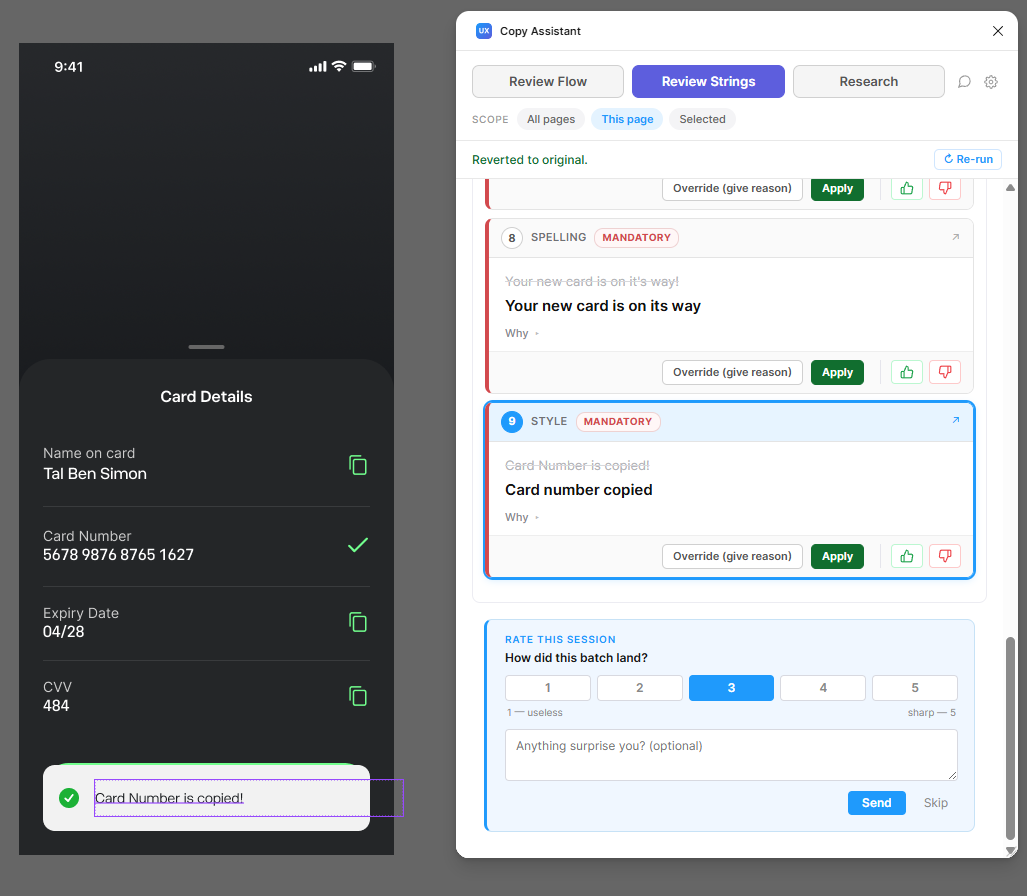
Title Case on buttons, no exclamation marks, regulated financial terms — every finding replaces Reject with Override (give reason), and every override is POSTed to a Postgres dashboard so I can see where rules get bypassed too often.
Where it fits
From "here's a mess" to an AI agent enforcing the standards at design time.
The plugin is the first concrete piece of the AI-based content system I pitched to R&D leadership. Standards from the style guide are now enforceable in the place where PMs and designers actually work — earlier in the lifecycle, before copy ever reaches a key/value sheet.
⬅ Back to the full content-strategy arc